

Blog
Desk Job Aches and Pains: How SoftWave Therapy Helps Rochester's Office Workers
When the Desk Fights Back: Aches and Pains That Follow Rochester's Office Workers Home
If you spend your workday at a keyboard, you already know the feeling. The dull ache that settles between your shoulder blades by mid-afternoon. The stiff neck that follows you home. The low back that protests when you finally stand up from a long meeting. Whether you commute downtown, work from a home office in Brighton, or split your week between the two, the modern desk job asks a lot of the human body. At Camarata Chiropractic in North Chili, Dr. Sam Camarata sees these patterns constantly, and he offers a non-invasive option that goes after the tissue behind the ache: SoftWave TRT therapy.
This article walks through why sitting takes such a toll, the simple habits that help, and how SoftWave Therapy is designed to support the muscles, tendons, and connective tissue that carry the load all day.
Why Sitting Hurts More Than It Looks Like It Should
Sitting seems restful. In reality, holding one posture for hours is hard work for the soft tissue that stabilizes your spine, shoulders, and hips. When a joint stays in the same position and the surrounding muscles rarely change length, circulation slows, tissue stiffens, and small areas of strain begin to build. Over weeks and months, that quiet accumulation is often what turns into the aches that so many desk workers describe.
A few patterns show up again and again:
- Neck and upper back tension. Leaning toward a monitor pushes the head forward of the shoulders. The muscles at the base of the skull and across the upper back then work overtime just to hold your head up, which is why that region so often feels tight and tired.
- Rounded, aching shoulders. Reaching for a mouse and keyboard for hours pulls the shoulders forward and inward. The muscles across the front of the chest shorten while those across the upper back stay stretched and strained.
- Low back stiffness. Sitting flattens the natural curve of the lower spine and quiets the muscles that support it. The discs and joints of the low back absorb steady pressure with little relief.
- Wrist and forearm strain. Repetitive typing and mousing keep the small tendons of the wrist and forearm under constant, low-grade tension, which can lead to the nagging soreness many keyboard users know well.
None of these problems come from a single dramatic injury. They come from repetition and position, and that is exactly why they respond well to a combination of better daily habits and care aimed at the tissue itself.
The Foundation: Ergonomics and Movement
Before any therapy, the daily setup matters. Small adjustments to your workstation reduce the strain your body absorbs hour after hour. A few basics go a long way:
- Set your monitor so the top of the screen sits near eye level, keeping your head balanced over your shoulders instead of jutting forward.
- Keep your elbows close to your sides at roughly a right angle, with wrists relaxed and straight rather than bent up or down while typing.
- Support the natural curve of your low back with a chair that fits you, and keep your feet flat on the floor or a footrest.
- Position your mouse close to your keyboard so you are not repeatedly reaching to the side.
Just as important is movement. The best posture is the next one. Standing up, rolling your shoulders, and walking for a minute or two every half hour restores circulation and gives strained tissue a break. A short walk at lunch, even in a Rochester winter when you circle the building instead of the block, keeps blood moving and muscles awake. These habits are the foundation. They will not, however, always undo strain that has been building for years. That is where SoftWave Therapy enters the picture.
How SoftWave Therapy Addresses the Underlying Tissue
Ergonomics reduces the load, and movement keeps tissue mobile, but neither directly stimulates the repair of soft tissue that has been under strain for a long time. SoftWave TRT is designed to do exactly that. It uses electrohydraulic, spark-generated acoustic waves delivered through a patented parabolic reflector. This creates a broad-focused shockwave, and SoftWave is the only technology that produces this particular broad-focused wave, as opposed to the radial, electromagnetic, or piezoelectric approaches used elsewhere. The wave penetrates deep into tissue and is designed to trigger the body's own healing cascade in the areas that need it.
Here is what that means in plain language:
- Stem cell activation. The waves are designed to stimulate the body's own resident stem cells and encourage them to migrate toward areas of strain.
- Better blood flow. SoftWave supports angiogenesis, the formation of new blood vessels, through signals such as VEGF and eNOS, which may help nourish tired, overworked tissue.
- Tissue repair signals. Markers including PCNA and BMP are associated with cell proliferation and collagen formation, part of how the body rebuilds healthy connective tissue.
- Calmer inflammation. The therapy is designed to modulate inflammation and help regulate the toll-like receptor response, part of how the body manages ongoing irritation.
Because desk-job aches are rooted in soft tissue that never gets a real chance to recover, an approach that supports the body's repair process from within is a natural fit. SoftWave does not mask the ache. It is designed to help the tissue underneath it heal.
Ready to see if SoftWave Therapy is right for you? Request your SoftWave Discovery Day in Rochester today.
What to Expect at Camarata Chiropractic
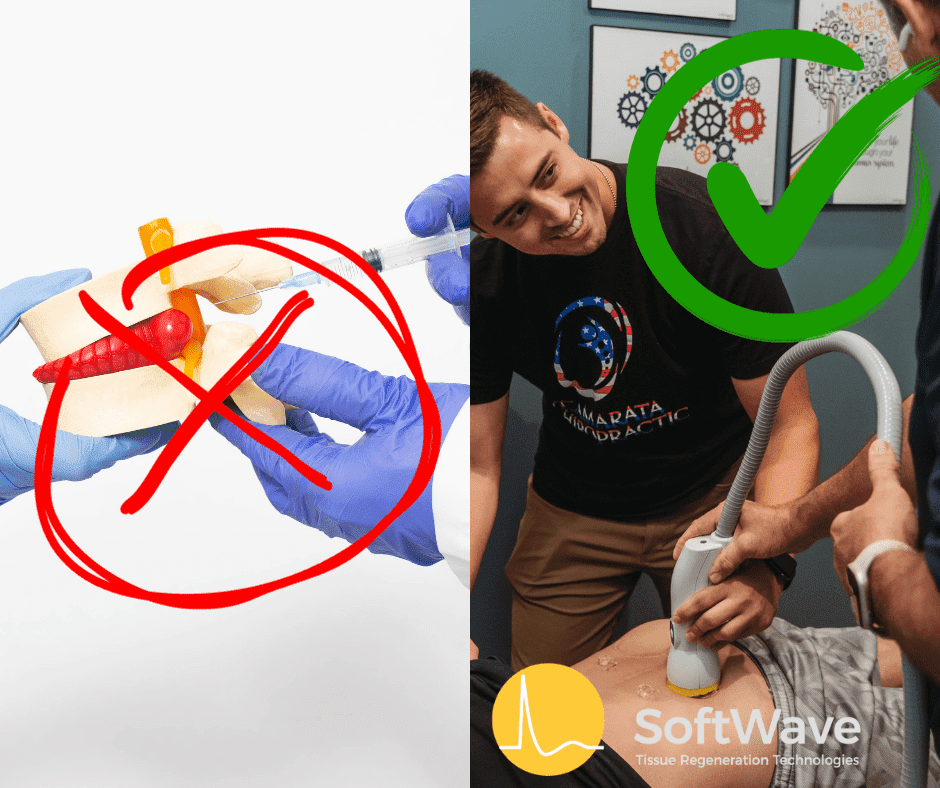
For busy professionals, the practical details matter as much as the science. SoftWave sessions are non-invasive. There are no needles, no drugs, no surgery, and no downtime, so you can return to work or the rest of your day right away. Each session typically runs about 10 to 15 minutes, and care is usually delivered as a series over roughly 6 to 8 weeks. One detail patients appreciate: the body's healing response continues for weeks and even months after the final session, so progress can keep building after your visits wrap up.
SoftWave technology has been studied at leading institutions and is used by clinicians who work with professional and collegiate athletes, the same demand for tissue recovery that a long-time desk worker faces in a quieter, slower form. Dr. Camarata will talk through your history, your workday, and your goals, then help you understand whether SoftWave fits your situation. Many patients report meaningful relief, and the therapy may help support recovery, though it is not a guaranteed cure and does not replace medical advice.
Small Changes, Real Support
The most durable results usually come from combining approaches: a workstation that fits your body, regular movement through the day, and care that supports the tissue carrying the load. Together, those pieces give office workers across the Rochester area a realistic path toward feeling better at the end of a long day.
Ready to Take the Next Step?
If desk-job tension in your neck, shoulders, back, or wrists has become part of your daily routine, you do not have to simply live with it. Let us help you get to the tissue behind the ache and support your body's own recovery.
Request your SoftWave Therapy new patient visit online today
Contact Camarata Chiropractic
Camarata Chiropractic
3237 Union St
North Chili, NY 14514
Phone: 585-617-4145
Our Main Office Website: https://www.camaratachiropractic.com
‹ Back