
Blog
SoftWave Therapy for Chronic Pain: A Drug-Free Path When Medications Aren't Enough

When the Medications Stop Feeling Like Enough: A Drug-Free Look at Chronic Pain in Rochester
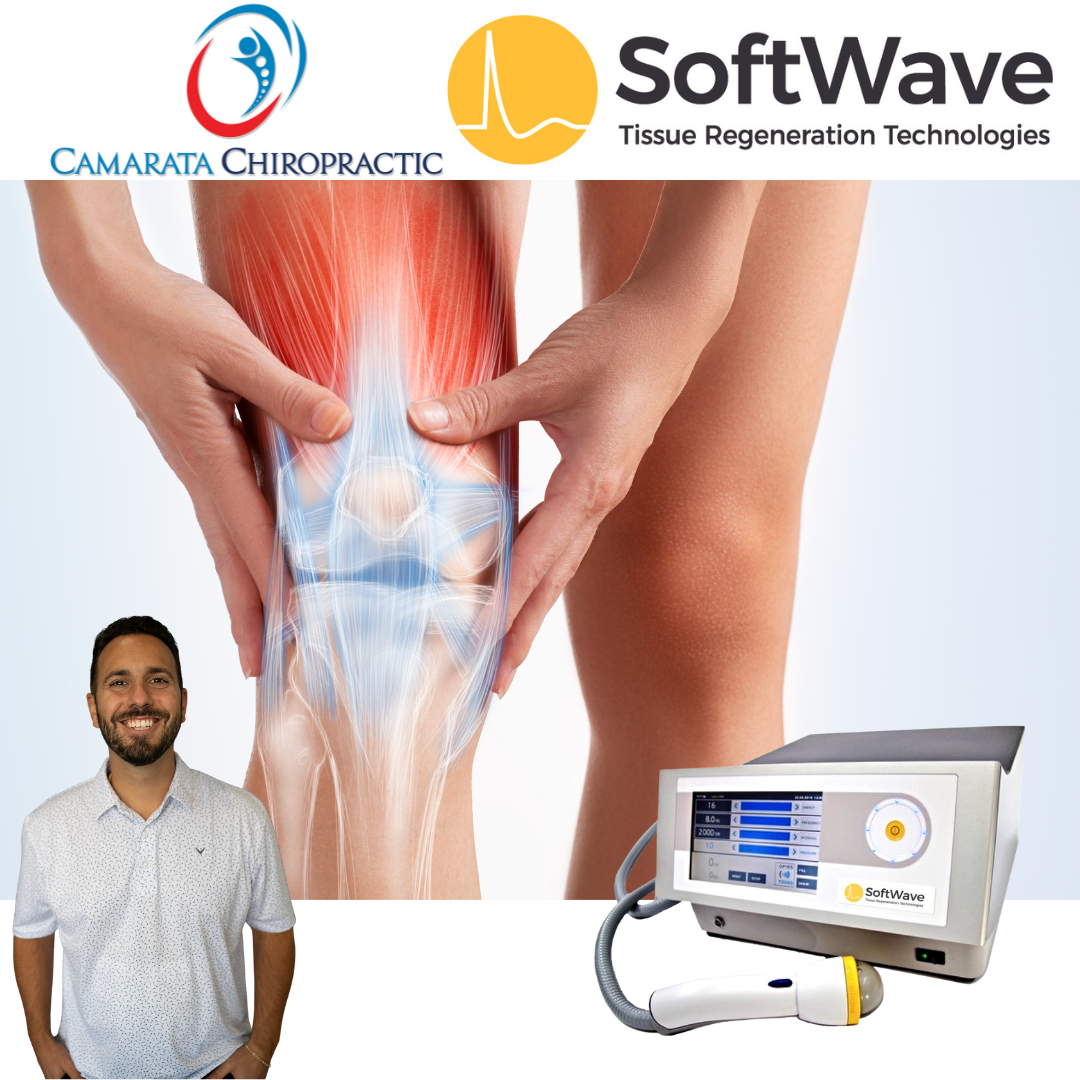
If you live with chronic musculoskeletal pain, you already know the quiet arithmetic of daily life. You count the hours until the next dose. You weigh whether a task is worth the flare-up that might follow. And somewhere along the way, you may have started to wonder whether the pills that once helped are really helping anymore, or just holding the line. Many people in Rochester who have leaned on pain medication for months or years reach a point where they want something different: not a stronger prescription, but an approach that works on the source of the pain rather than the volume dial. At Camarata Chiropractic, Dr. Sam Camarata offers SoftWave Tissue Regeneration Technology (TRT) as a non-invasive, drug-free option worth understanding for exactly this situation.
Before we go further, one important note. This article is meant to inform, not to advise you on your prescriptions. Please do not start, stop, or change any pain medication on your own. Those decisions belong to you and the provider who manages your care. What we can do here is explain how SoftWave works and why a growing number of people who are tired of relying on medication are curious about it.
Masking the Signal Versus Addressing the Tissue
Most common pain medications, whether over-the-counter NSAIDs or prescription options, are built to change how you perceive pain or to quiet inflammation while your body does whatever healing it can on its own. That can be genuinely valuable, especially in the short term after an injury or during a difficult flare. The challenge with long-term reliance is that these medications generally do not repair the underlying tissue. When the dose wears off, the original problem is often still there, which is why the cycle can feel endless.
SoftWave takes a different aim. Rather than working primarily on your perception of pain, it is designed to interact with the tissue itself and to prompt the body's own repair processes. The goal is not to cover the signal but to help address some of what is generating it. For someone who is worn out from managing symptoms week after week, that shift in strategy is often the whole appeal.
What SoftWave Therapy Actually Is
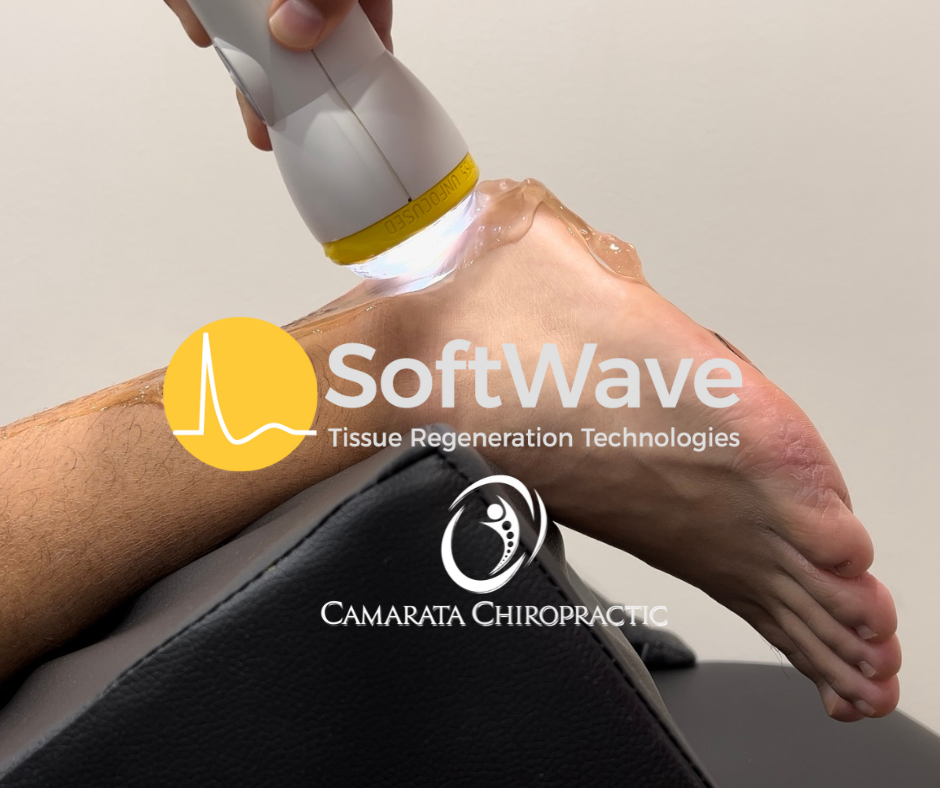
SoftWave TRT uses electrohydraulic, spark-generated acoustic waves. Inside the applicator, a controlled spark creates an acoustic wave that is spread across the tissue by a patented parabolic reflector. This produces what is called a broad-focused shockwave. That detail matters more than it sounds. SoftWave is the only broad-focused shockwave technology, which sets it apart from radial, electromagnetic, and piezoelectric devices. The broad-focused wave is able to reach deep into tissue and spread its energy over a wider area, which is designed to trigger the body's natural healing cascade where the trouble actually lives.
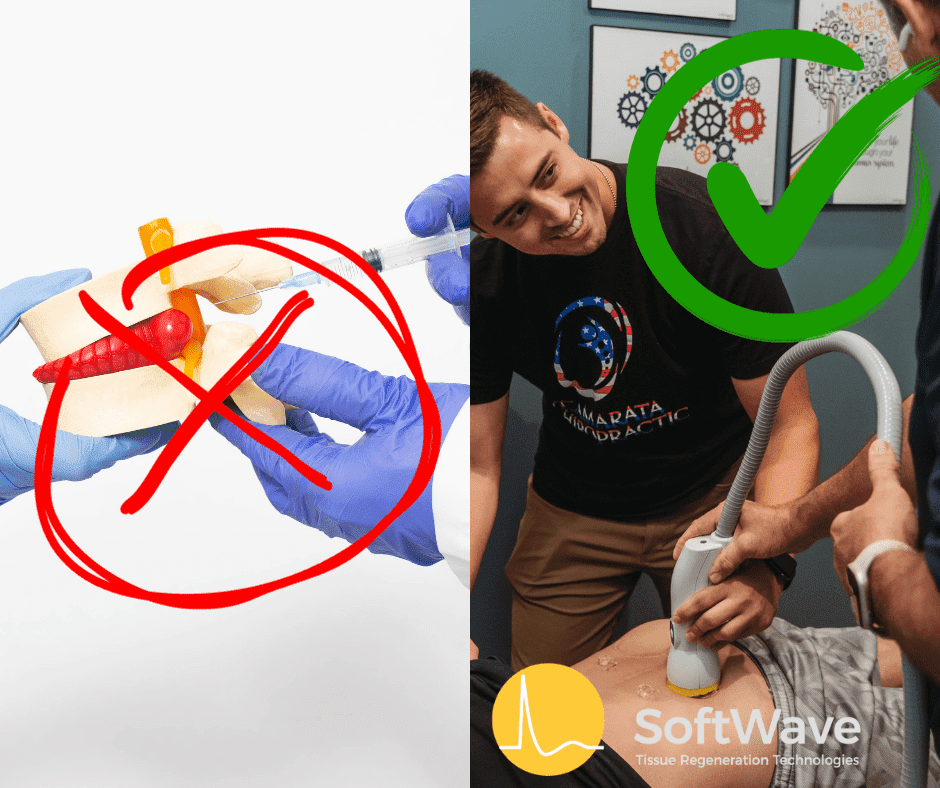
Just as important is what SoftWave is not. There are no needles, no drugs, no surgery, and no downtime. A typical session lasts only about ten to fifteen minutes. For people who have grown cautious about adding one more substance to their system, the drug-free, non-invasive nature of the treatment is a meaningful part of the picture.
How SoftWave Is Thought to Help
The science behind SoftWave centers on encouraging the body to do repair work it may have slowed down on. In plain language, the therapy is designed to support several natural processes:
- Stem cell activation: the waves are believed to stimulate resident stem cells and encourage them to migrate toward the treated area, where the body can put them to work.
- New blood vessel growth: through signals such as VEGF and eNOS, SoftWave aims to promote angiogenesis, the formation of new blood vessels, which supports circulation to tissue that may have been starved of good blood flow.
- Cell proliferation and collagen: markers such as PCNA and BMP are associated with the body building new cells and producing collagen, part of how tissue rebuilds its structure.
- Calmer inflammation: the therapy is thought to help modulate inflammation rather than simply suppress it, and to regulate toll-like receptors involved in the body's response.
- Cellular housekeeping: it may also support the clearance of senescent, or worn-out, cells that can linger and interfere with healing.
These are the mechanisms researchers point to, and SoftWave has been studied at leading institutions and is used by clinicians who work with professional and collegiate athletes. What no honest provider will tell you is that it guarantees a cure. It does not. Every body and every case of chronic pain is different, and results vary from person to person.
Why a Drug-Free Approach Appeals to Chronic Pain Sufferers
The interest in options like SoftWave is not hard to understand. Long-term use of certain pain medications carries well-documented concerns, from stomach and kidney strain with some NSAIDs to the serious risks associated with opioids. Wanting to avoid or reduce that exposure over time is a reasonable and responsible goal, and it is one many Rochester patients bring through the door. SoftWave gives them a path to pursue that does not add anything to their body's chemistry at all.
It is worth being clear about the relationship between the two. SoftWave is not a switch you flip to abandon your medication overnight, and no one should approach it that way. Instead, think of it as a way to work on the underlying tissue while you and your prescribing provider make any decisions about medication together, on your timeline, based on how you respond.
Ready to see if SoftWave Therapy is right for you? Request your SoftWave Discovery Day in Rochester today.
What to Expect at Camarata Chiropractic
SoftWave is generally delivered as a series rather than a single visit. Many patients complete a course over roughly six to eight weeks, with each individual session taking just those ten to fifteen minutes. One feature people appreciate is that the body's healing response does not stop when the sessions do. Because the therapy is prompting your own biology, that regenerative activity can continue for weeks to months after your final appointment.
Dr. Sam Camarata begins with an evaluation to understand your history, your pain, and your goals, and to determine whether SoftWave is a sensible fit for your situation. Because the treatment is non-invasive and drug-free, it can often be considered by people who are not candidates for, or simply want to avoid, more aggressive interventions. Many patients report feeling encouraged by having a plan that focuses on tissue rather than on chasing symptoms, even when they keep working with their other providers at the same time.
An Honest Place to Start
If years of medication have left you managing pain instead of moving past it, you are allowed to ask whether there is another road. SoftWave will not be the answer for everyone, and it is not a replacement for the medical guidance you already trust. But for people who want to address the underlying tissue and reduce their long-term reliance on drugs where it is safe and appropriate to do so, it is a conversation worth having.
Ready to Take the Next Step?
If you are tired of simply masking chronic pain and want to explore a drug-free approach that works on the tissue itself, Dr. Camarata and the Rochester team are here to answer your questions with no pressure. Keep partnering with your own provider on medication decisions, and let us help you understand whether SoftWave belongs in your plan.
Request your SoftWave Therapy new patient visit online today
Contact Camarata Chiropractic
Camarata Chiropractic
3237 Union St
North Chili, NY 14514
Phone: 585-617-4145
Our Main Office Website: https://www.camaratachiropractic.com
‹ Back